
A finished basement adds usable square footage to your home and real value to your property — but the quality of the space begins with what happens before the drywall goes up. The electrical rough-in is the foundation that everything else in a finished basement depends on: every outlet location, every lighting circuit, every dedicated circuit for a home theater, wet bar, or home office has to be planned and installed before the walls close. At Z-Electric LLC, we provide complete basement wiring services throughout Colorado Springs, CO, and the surrounding communities, handling the full electrical scope from rough-in through trim-out so your finished basement is wired correctly, code-compliantly, and exactly the way you planned it.
Basement wiring involves more planning and more coordination than most homeowners expect, particularly in Colorado Springs homes where the basement is often the most versatile space in the house. Our licensed electricians work through the layout with you before any wire is pulled — discussing outlet placement, lighting zones, dedicated circuits for specific uses, and how the new circuits integrate with your existing panel. We perform the rough-in, coordinate with your inspector, and complete the trim-out once the walls are finished, leaving you with a basement that is properly wired from the start and ready to function however you intend to use it. Every project is backed by our lifetime workmanship warranty.
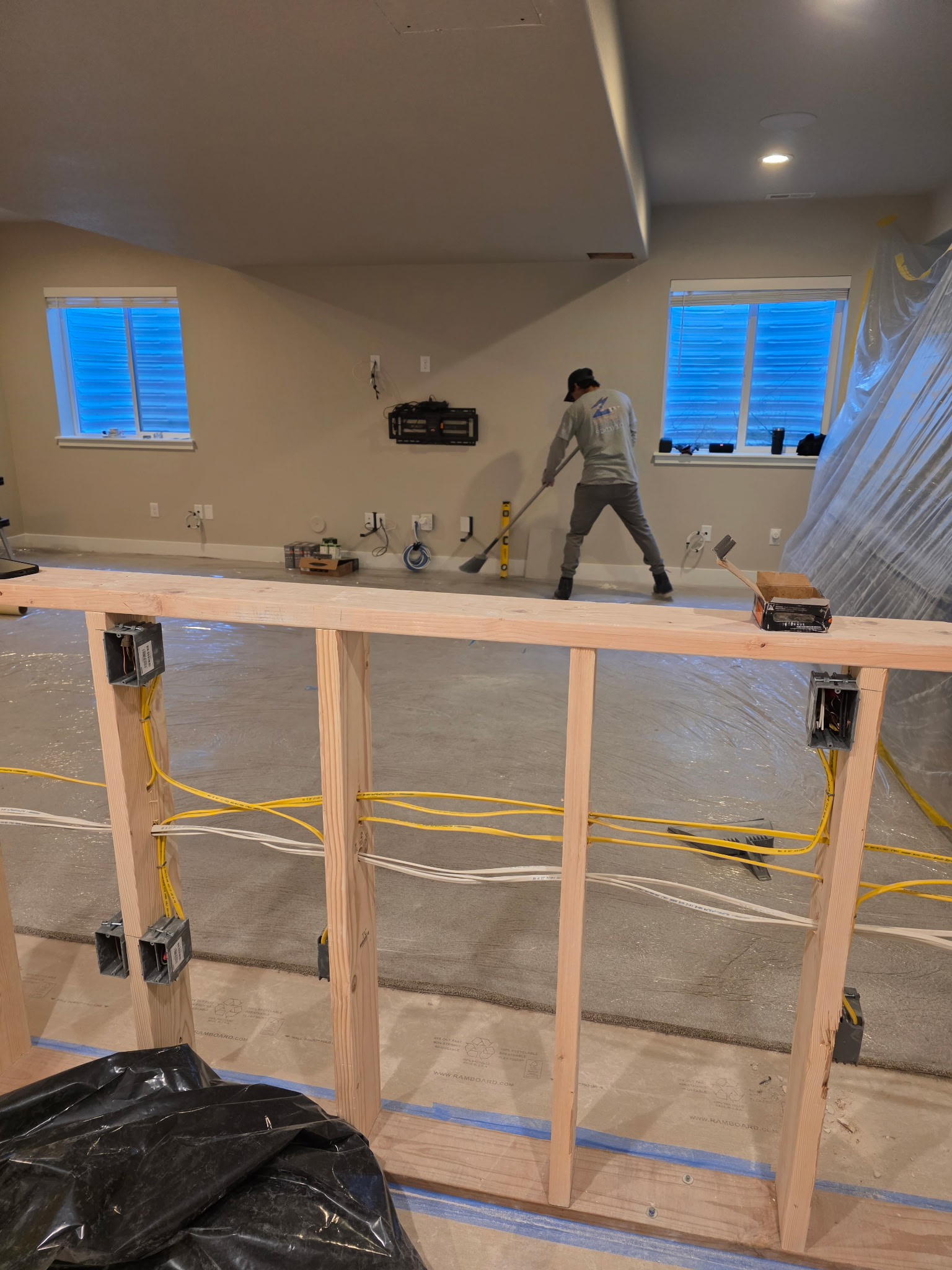
Finishing a basement is one of the few home improvement projects where the order of operations matters in a way that has long-term consequences. Unlike a kitchen renovation where most of the electrical work can be accessed through existing wall cavities and junction boxes, a basement finish is typically a one-shot opportunity to get the wiring right before framing, insulation, and drywall lock everything in place. The decisions made during the rough-in phase — how many outlets per room, where the lighting circuits are controlled from, whether a wet bar or home theater gets dedicated circuits — determine what the finished space can and cannot do for the entire life of the home.
The NEC requirements for finished basement spaces reflect the same standards that apply to any habitable room in the home. Every bedroom — including basement bedrooms — requires arc fault circuit interrupter (AFCI) protection on the wiring, which is a code requirement that a significant number of basement finish projects get wrong either because the homeowner is doing some of the work themselves or because a less experienced contractor is not current on code. Basement spaces that include bathrooms require GFCI protection at those circuits. Egress requirements for basement bedrooms have specific window size and sill height requirements that interact with where electrical outlets and switches can be placed. Getting these requirements right from the beginning prevents failed inspections, required demolition, and the cost of doing work twice.
Panel capacity is the other piece that homeowners frequently underestimate at the start of a basement project. A typical basement finish adds multiple new circuits to the home's electrical load — general lighting circuits, outlet circuits for each room, dedicated circuits for entertainment equipment, HVAC considerations for the finished space, and sometimes a dedicated circuit for a mini-split or electric baseboard heater if the basement is not served by the existing HVAC system. In older Colorado Springs homes running on 100-amp service, that addition can push the panel to or past its capacity, which needs to be identified at the planning stage rather than discovered mid-project.
When Z-Electric LLC takes on a basement wiring project, we start with a planning conversation that covers how each area of the basement will be used, what circuits are needed for each zone, and what the existing panel can support. We perform a load calculation before pulling a single wire and identify any panel work that needs to happen before the rough-in begins. The rough-in is completed in coordination with the framing schedule so wiring is in place before insulation and before the inspection. After the inspection passes, we coordinate the trim-out once the drywall is finished and painted, installing outlets, switches, and light fixtures at each location. The finished basement has every circuit it needs, every outlet where it needs to be, and documentation confirming the entire installation was inspected and approved.
The electrical rough-in is the most important phase of a basement finish. Here is what professional basement wiring services from Z-Electric LLC deliver.
We plan the full electrical layout before any wire is pulled — outlet placement, lighting zones, dedicated circuits, and switch locations — so the rough-in reflects exactly how the finished space will function.
Finished basement bedrooms require AFCI protection, and bathroom circuits require GFCI protection. We install the correct protection type for each circuit and location, ensuring the installation passes inspection the first time.
We calculate the additional load the new basement circuits will add to your existing panel and confirm it has the capacity to support them. If a panel upgrade is needed, we identify that before the project starts rather than mid-construction.
We time the rough-in to align with the framing schedule so wiring is complete before insulation goes in and before the electrical inspection. Proper sequencing prevents delays and avoids any rework.
We return to complete the trim-out — installing outlets, switches, and fixtures — once the drywall is finished and painted, so the final installation looks clean and is not damaged during the finishing process.
Complete basement wiring is the foundation. Here are the specialized basement electrical services we provide throughout Colorado Springs and the surrounding area.
Our full basement finish electrical service covers the complete scope from rough-in planning through trim-out installation — every circuit, outlet, lighting zone, and dedicated connection the finished space requires.
A home theater is one of the highest-value basement upgrades a homeowner can plan, and the electrical behind it requires specific dedicated circuits, outlet placement, and in-wall wiring routes that have to be built into the rough-in before the walls close.
Recessed LED lighting transforms a finished basement from a utilitarian space into one that genuinely functions as a room. We plan and install basement recessed lighting with the same precision we bring to above-grade installations.
Basement wiring is a project where the planning matters as much as the installation. We bring both.
We are involved from the initial layout discussion through the final fixture installation. You have one electrician who knows the full scope of your project at every phase, not a different crew showing up at each step.
AFCI requirements, egress rules, and basement-specific code provisions change regularly. We are current on the requirements that apply to finished basement spaces in Colorado Springs and El Paso County, which is how we keep projects out of inspection trouble.
We explain the reasoning behind every circuit recommendation — why a dedicated circuit is needed here, why outlet spacing matters there, why a given switch location makes more practical sense than another. You understand the decisions going into your basement.
Every circuit, connection, outlet, and fixture we install is backed by our lifetime workmanship warranty. The electrical work in your finished basement is built to last as long as the space itself.
We serve Colorado Springs, Falcon, Peyton, Monument, Fountain, Pueblo, Manitou Springs, Security, Widefield, Black Forest, and surrounding communities. Contact us for a free estimate on your basement wiring project.
The rough-in should happen after framing is complete and before insulation is installed. This gives the electrician full access to the framed wall and ceiling cavities to run wire, install boxes, and route circuits without obstruction. The rough-in must be inspected before insulation and drywall cover it.
The NEC requires at least one outlet on each wall that is two feet or longer, with no point along the wall more than six feet from an outlet. Bedroom circuits must also have AFCI protection. In practice, we typically install more outlets than the code minimum to ensure the room is genuinely functional for how people actually use bedroom spaces.
Yes. The NEC requires AFCI protection on circuits feeding bedroom spaces, including basement bedrooms. AFCI breakers detect the electrical signatures of arcing faults — a leading cause of residential electrical fires — and interrupt the circuit before a fire can start. We install AFCI protection on all basement bedroom circuits as a standard part of every basement wiring project.
It depends on the panel's current load and available capacity. A typical basement finish adds four to eight new circuits depending on the scope and how the space is used. We perform a load calculation during the estimate and confirm whether your panel can support the addition or whether a panel upgrade is part of the project scope.
Yes. New electrical wiring in a finished basement requires a permit and inspection in Colorado Springs and El Paso County. The rough-in must be inspected before insulation and drywall are installed. We manage the permitting process and coordinate the inspection schedule so the project timeline is not disrupted.
FAQs reviewed by George Zuniga, owner of Z-Electric LLC, a licensed, insured, and certified electrician.
The electrical rough-in is the one phase of a basement finish that cannot be revisited once the walls are closed. Z-Electric LLC provides complete basement wiring services throughout Colorado Springs and the surrounding area, from pre-construction planning and panel evaluation through rough-in, inspection, and final trim-out — all backed by our lifetime workmanship warranty. Contact us today for your free estimate and make sure the electrical foundation of your finished basement is done right.
Business Name: Z-Electric LLC
Address: Colorado Springs, CO, 80925
Phone: 719-663-8783
Business Hours:
Mon - Fri: 08:00 AM to 05:00 PM
Sat-Sun: Closed
Available For Emergency Calls Only
Financing through Housecall Pro.
Workmanship is for life.
10% off to all first-time customers.